.png)
Captain Matthew Flinders R.N.
Updated: Sep 3
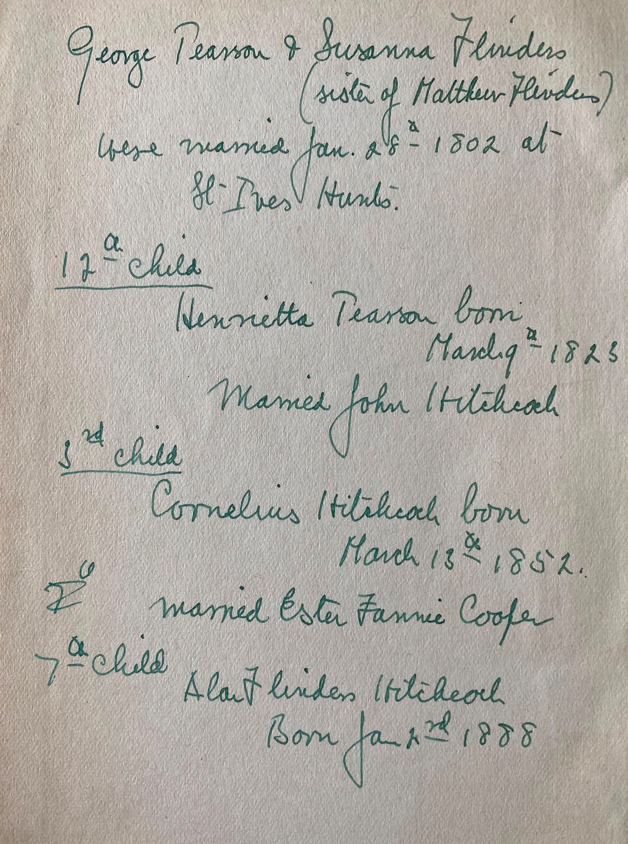
My passion for family history was ignited at about the age of 10 by my grandfather John Hitchcock and great grandfather Alan Flinders Hitchcock who told me about Captain Matthew Flinders RN who was the first to circumnavigate the coast of Australia, we are descended from his sister Susannah Flinders (1779-1827). I was so interested, my great grandfather, before he died, left me a precious book about Matthew Flinders which is still a treasured possession. I also spent a lot of my childhood in my grandparents beautiful Tudor farmhouse where there were various portraits of ancestors on the walls, this also sparked my fascination with those people.



For those who don’t know about Captain Flinders, he was born 16th March 1774 in Donington, Lincolnshire, the son of Matthew Flinders, a surgeon and his wife Susannah. Matthew Flinders was inspired to go to sea against the wishes of family and friends after reading Robinson Crusoe. He joined the Navy at the age of 15.
In May 1791 Flinders sailed with Captain Bligh, (this was two years after Bligh’s voyage which had resulted in the Mutiny on the Bounty). In Feb 1792 they arrived at Adventure Bay off the southeast coast of Tasmania. This was Flinder’s first experience with landing in what we now know as Australia.
After a stint on HMS Bellerophon and the battle of the Glorious First of June where he witnessed his captain losing a leg, Flinders decided to pursue exploration rather than military action.
In 1795 Flinders enlisted as a midshipman aboard HMS Reliance which went to New South Wales, Flinders became friends with the ships surgeon George Bass who was also a native of Lincolnshire.
In 1798 Flinders was a lieutenant and was given orders to sail beyond Furneux’s Islands and look for a straight and pass through it and return by the south end of Van Dieman’s Land (Tasmania). Flinders completed the circumnavigation of Van Dieman’s Land and confirmed the presence of a straight which was named Bass Straight after his friend. During this voyage Flinders and Bass rowed a dinghy for miles up the River Derwent where they had their encounter with Aborigines.
In 1799 Flinders requested to explore the coast north of Port Jackson, this was granted. Bass had returned to Britain, and so Flinders recruited his brother Samuel Flinders, and they were also accompanied by an aborigine named Bungaree.
On 17th April 1801 Matthew Flinders married Ann Chappelle (1772-1852), he had hoped to take her with him, and even brought Ann aboard ship, but the Admiralty learned of his plans, they had strict rules against wives accompanying captains, he was ordered to remove her. Ann had to stay at home and would not see her husband for nine years.
Between 1796 and 1803 Matthew Flinders surveyed the Australian coastline in the ship “Investigator”. This voyage was funded by the British Admiralty and was a voyage of science and exploration to provide an accurate chart of the Australian coastline and study the plant and animal life of Britain’s newest colony. He was the first known European to navigate the Australian continent, his charts are in the National Maritime Museum in Greenwich.
In 1803 Matthew Flinders decided to set sail for Britain. He was captured in Mauritius and detained there until June 1810. At this point he was promoted to Captain. Whilst imprisoned in Mauritius he wrote long letters to his wife.
Matthew Flinders also wrote about his ship’s cat called “Trim” who accompanied him between 1799-1804. Trim survived the circumnavigation of Australia, survived a shipwreck in 1803 and was imprisoned in Mauritius with Flinders. Flinders reported that he was “devoured by Catophagi of that island”. Flinders wrote a very lengthy tribute to Trim ending in this epitaph:
To the memory of Trim,
the best and most illustrious of his Race, –
the most affectionate of friends, –
faithful of servants,
and best of creatures. He made the Tour of the Globe, and a voyage to Australia,
which he circumnavigated; and was ever the
delight and pleasure of his fellow voyagers.
Returning to Europe in 1803, he was shipwrecked
in the Great Equinoxial Ocean; This danger escaped, he sought refuge and assistance at the Isle of France, where
he was made prisoner, contrary to the laws of
Justice, of Humanity, and of
French National Faith; and where, alas! he terminated his useful career, by an untimely death, being devoured by the Catophagi of
that island. Many a time have I beheld his little merriments with delight,
and his superior intelligence with surprise:
Never will his like be seen again! Trim was born in the Southern Indian Ocean, in the year 1799,
and perished as above at the Isle of France
in 1804.
Peace be to his shade, and
Honour to his memory
He finally arrived in England in October 1810, by which time he was in very poor health, but he immediately resumed work on a book and atlas of maps, which was called “A Voyage to Terra Australis: undertaken for the purpose of completing the discovery of that vast country, and prosecuted in the years 1801, 1802, and 1803 in His Majesty's ship the Investigator, and subsequently in the armed vessel Porpoise and Cumberland Schooner. With an account of the shipwreck of the Porpoise, arrival of the Cumberland at Mauritius, and imprisonment of the commander during six years and a half in that island”. This was published in 1814. Original copies are held at the Mitchell Library in Sydney.
Flinders died aged 40 on 19th July 1814 of kidney disease, the day after his book and atlas were published. He was laid to rest at St James’ Church, Picadilly. In 1878 Euston Railway Station was expanded and Flinders’ grave was thought to lie under a station platform. Flinders’ grave was located in January 2019 by archaeologists and his coffin identified by its coffin plate. His remains were reinterred at the Church of St Mary and the Holy Rood in Donington on 13th July 2024. There is a statue of Matthew Flinders R.N. at Euston Station and a pub at Euston has been named The Captain Flinders.

Matthew Flinders is not so well known in the UK and did not use his own name for any of his discoveries in Australia, but is highly revered in Australia where there are plant species, a university, a river, a mountain range, an island, a Royal Australian Navy frigate, highways, a national park, schools, statues and monuments named after him. He also appeared on a bank note and postage stamps. He is considered the main explorer of the state in South Australia.
This is a very synopsis of Matthew Flinder’s story and there is a huge amount of information about his life and extensive adventures which I haven’t included here but which can be found all over the internet including at the National Maritime Museum:https://flinders.rmg.co.uk/index-2.html


Comments