.png)
Robert Hitchcock (c. 1611 - 1665) of Copdock, Suffolk & the Matthew Hopkins Witch Trials
- Sheila Herd
- Jul 3
- 7 min read
Updated: 3 days ago
Recently I took a very deep dive into my own paternal family history as one of my portfolio pieces of research for the Diploma qualification with the Institute of Heraldic & Genealogical Studies, and what I found gave me quite a shock.
Robert Hitchcock (circa 1611 – 21st April 1665
Robert Hitchcock was my 8x great grandfather, my maiden name was Hitchcock.
Robert was baptised in Wherstead, Suffolk on 21st July 1611.[1] He was the only son of Geoffrey and Rose Hitchcock who originated from Long Melford, and settled in Chattisham. Geoffrey was baptised in Long Melford in November 1580, the son of Thomas and Katherine Hitchcock of Long Melford. In his will written in 1636 Geoffrey was recorded as a miller.[3] There was a water mill in Lower Barn Road, Chattisham, near the boundaries of Hintlesham and Washbrook. Geoffrey may have left Long Melford to escape plague epidemics. In Geoffrey’s will, he bequeathed to his only son Robert as follows: “I give and bequeath unto ROB[ER]TE my sonne the said peece or prcell of lands called or knowne by the name of Belchams croft.” Belchman of Betsman’s Croft was a piece of land, 3.5 acres in Chattisham, now a village playing field. Geoffrey had also left his widow Rose, and his four surviving daughters well provided for.
Robert Hitchcock was recorded in March 1639 as paying 8s 4d ship money as a resident of Copdock. His mother, Rose Hitchcock was recorded as a widow paying 3s ship money in Chattisham.
Robert’s life spanned incredibly turbulent times in English history. In 1626 Charles I came to the throne, he was an unpopular ruler who believed in the divine right of Kings and was perceived as tyrannical. Dissatisfaction with Charles I led to a growing Puritan movement, who definitely did not believe in a divine right of kings, which led to regime change. Charles I fought the civil war with Oliver Cromwell from 1642 until his execution in Jan 1649.
England was a commonwealth from 1642 until 1660 when Charles II returned from exile.
In August 1642 the Stour Valley Riots took place. East Anglia had strong Puritan sympathies and supported Oliver Cromwell and the parliament in the civil war, Royal authority was collapsing.

Anti popery riots occurred in the area surrounding River Stour on the Essex / Suffolk border. There was anxiety about the wealth of certain Catholic families, and a widespread belief that there was a Papal plot to return the country back to Roman Catholicism. High unemployment as a result of a decline in the cloth industry and wool trade caused a rise in poverty, as did a succession of bad harvests, famine, men away at war and increased taxes imposed by Charles I.
Significant riots occurred with crowds attacking clergymen and gentry. One such member of the Catholic gentry whose property was destroyed was Henry Foster of Copdock Hall. Foster believed that the instigators came from nearby Ipswich, where rumours were spread that the Fosters were harbouring a secret army to return the country to royalists and the Catholic faith. Foster also referred to the astonished and tearful reaction of one ‘squire Bloisse’ to the destruction, which in turn might account for why the direction of the politicized mob was more effectively directed to witches than gentry Catholics.[
In January 1643, William “smasher” Dowsing came to Copdock. William Dowsing was a Puritan and iconoclast (iconoclast = the belief in the importance of the destruction of icons for religious or political reasons). In December 1643 the Earl of Manchester appointed Dowsing “Commissioner for the destruction of monuments of idolatry and superstition”. His role was to carry out a parliamentary ordinance which stated that “all monuments of superstition and idolatry should be removed and abolished”. This included fixed altars, altar rails, chancel steps, crucifixes, crosses, images and pictures of any one of the persons of the Trinity and of the Virgin Mary. In May 1644 this was expanded further to include angels, rood lofts, holy water stoops and images in stone, wood and glass and on plate.
Dowsing visited over 250 churches in Suffolk and Cambridgeshire. He recruited others to help him, and sometimes local residents helped in the destruction. Each church was charged a noble (one third of a pound) for his services. Dowsing left journals of his work.
COPDOCK, Jan the 29th 1643. I brake down 150 superstitious Pictures, 2 of God the Father, and 2 Crucifixes; did deface a Cross on the Font; and gave order to take down a stoning Cross on the Chancel, and to levell the steps; and took up a Brass Inscription, with era pro nobis, and eujus propitietur Deus. (Pray for us and may God have mercy on him).[
In May 1644 Copdock was impacted by the “Suffolk Committees for Scandalous Ministers”. These committees were authorized to hear evidence against any minister or school master who was “scandalous”. Scandalous ministers were “any minister who was non-resident, incompetent or idle, scandalous either in life or in doctrine, or in any way ill-affected to Parliament”.
In other words, they could also intervene against clergymen with Royalist sympathies.
The following was reported from Copdock church:
That the said William Aldus upon the Lord’s daye, being the 12th day this instant May, in the parish church of Cobdocke in the forenoone did publickly read the confession, absolution & other part of the service in the booke called the service booke. (Nathaniel Ralfe, Robert Hitchcock).
Proved and ejected 13th May 1644.[7
Proved and ejected meant that the Rev Aldus was ejected from his ministry in the parish of Copdock.
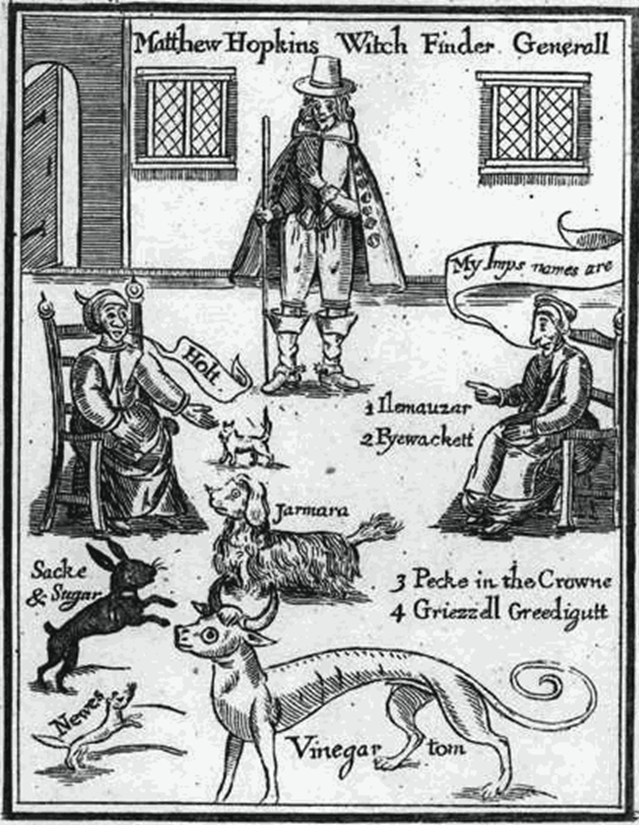
In August 1645 witch hunting came to Copdock. Matthew Hopkins was the son of a puritan minister and was born in Wenham. Hopkins began his career as self-appointed “witch finder general” in Manningtree in March 1644 until his retirement in 1647. Times of hardship meant that communities searched for scapegoats, neighbours turned on one another, witches were working against God and had to be searched out and stopped.
Mother Phillips and Mother Mills were recorded as being searchers, it is not known if they were local to Copdock, or if they were women who travelled around with Matthew Hopkins and his deputy John Stearne.
Watchers observed the accused and examined their bodies for the devil's mark, this could be physical signs like moles or scars. If a person bore a devil's mark, it was believed that they would not feel pain or bleed. Witchfinders used tools such as a witch's prick, which had a hollow handle and a retractable point which would give the appearance of an accused witch’s skin being penetrated without blood or pain.
Those accused would be subjected to torture including swimming tests, forced walking, sleep deprivation and starvation.
Susan Manners, Alice Muntford, Jane Rivert and Mary Skipper were denounced as witches in Copdock. Depositions from three were recorded as follows:
Susan Manners of Copdock as before, after watching from Monday
until Wednesday she confessed that she had received 2 imps sis
& Kate from her grandmother and that she cryed out if her grand
mother for destroying her self & all her kindred. Witness. Robert
Hitchcock that these imps sucked her. Witness Thomas Bull.
Alice Muntford as before the same thing against her, it was testified
by the searchers that Mother Phillips and Mother Mills said that
some teats that were found about her were witches marks.
Mary Skipper the same thing, that after watching from Monday
until Wednesday she confessed that the devil appeared unto her
in the shape of a man after her husband’s death and told if she
would enter a covenant with him he would pay her debts and he
would carry her to heaven and she would never want, with
that she did & sinned it with her blood, and that he left her 3 imps and
that she employed one to kill Lane’s child and killed it, & that the
devil had her go church and make a great show but if she
attended dilligently he would nip her, she felt of a weak after and
that the devil have constantly had the use of her ever since, but
she felt him always cold. Witness Robert Hitchcock, true Rebecca
Ustwood.
The women were sent to Ipswich gaol, and then onto Bury gaol where they were tried, convicted and condemned to die. They were hung alongside 15 others on 27th August 1645. The following pamphlet was published showing names of three women from Copdock, as well as 3 women from Chattisham; Mary Bacon, Anne Alderman and Rebecca Morris.

In January 1646 the magistrates at Ipswich Quarter Sessions ordered that Arthur Jermey and Henry Parker "hear and determine differences between the inhabitants of Cobdocke and James Rigges gaoler of Ipswich as to payment of charges for witches upon the late order of Gaol Delivery". Put simply, the parish of Copdock was stuck with the bill for the gaoling of the women from Copdock, and they were not happy.
Matthew Hopkins began to face growing suspicion for profiteering from the witch trials, and the fact that despite many executions, misfortunes in communities had not stopped. Hopkins died of tuberculosis in 1647 aged 27.
On 4 July 1647, Benjamin Hubbard, a puritan preacher of Copdock, preached a sermon at nearby Belstead (dedicated to Thomas Blosse, high sheriff of Suffolk, and Nathaniel and Francis Bacon, JPs) which charted the defeat of Catholicism in the previous century. In the sermon, he lists noteworthy events including the following: "And many superstitious reliques were abolished, which neither we nor our godly fathers (as ye have heard) were able to beare. Since which time, ye know, many Witches have been discovered by their confessions, and executed; Many glorious victories obtained (beyond any man's expectation) and places of strength yielded, above seventy in eight months space. This is none other but the Lord hath done it ..."
Whilst all this was going on, Robert Hitchcock was increasing his land holding around Copdock, Hintlesham and Chattisham where he held land from Copdock Manor, Hintlesham and Hadleigh Manor and Chattisham Manor. Between 1646 and 1662 Robert’s name appeared most years on the list of jurors in the Manor of Copdock. (The jury, or homage, were sworn in at each manorial court sitting, acting as jurors and witnesses. Individuals serving on a jury were typically prominent persons within the manorial hierarchy, usually freeholders or yeoman status).
In 1664 he was recorded as paying Hearth Tax for 3 hearths in Capel St Mary. (The Hearth Tax was a tax on householders on the number of hearths in a dwelling which was levied in England and Wales between 1662 and 1689).
On 15th April 1665 Robert Hitchcock made his will in Capel St Mary, he was about 54 years of age. He died a few days later on 21st April and was buried in Capel St Mary on 23rd April 1645. His will was simple, he left all to his beloved wife Mary, trusting her to raise his children. Mary died two years later.[4]


Comments