.png)
Washbrook, Suffolk ~ Historic Houses History ~ Stebbings & Chelmesis
Updated: Sep 4

Introduction
We moved into our house called Stebbings in Washbrook, Suffolk in 2017. When we moved in, we inherited a packet of old deeds in a sweaty plastic bag. An acid free box was obtained to store them in, with the intention of examining them closely “at a later date,” which eventually happened for Institute of Heraldic & Genealogical Studies Diploma which provided an opportunity to take an in depth look at the families.
The aim of the research was to document in detail the history of the two properties, Stebbings and Chelmesis and the lives of the people who had lived here, going back in time.
The deeds gave information on the families who lived in Stebbings and a 15th Century timber framed house directly opposite Stebbings called Chelmesis, the two properties were for centuries linked together in the deeds. Chelmesis dates to earlier than 1526, it was at an unknown point in history extended and divided into three cottages which for ease have been called Chelmesis 1, Chelmesis 2 and Chelmesis 3.
Stebbings, as it is now, was built in the 1700's, possibly a lot earlier, and was extended in the 1820's by the Edwards family. We currently have builders here building a new roof for us, there is a date in the attic, and the letters "RFW", presumably the initials of a builder or labourer in the 1820's. The builders here currently have confirmed that the house was built in two parts. The front of the house is the oldest, and the rear of the house was added on by George Edwards in the 1820's.


I originally researched backwards in time, but to make it easier for readers to understand I've written this out from the earliest point, 1526, up to the present day.
The name "Washbrook" means 'Washing brook' or 'flooding brook', and to this day there are many springs, but back in the middle ages this attracted clothiers and drapers who made woollen cloth and dried it on tenter frames.
On 1 April 1994 the parish of Washbrook was abolished and merged with Copdock to form “Copdock and Washbrook”.
I have a huge amount of detail from census returns from 1841 through to 1939 on the families that lived in Chelmesis and Stebbings, but there was a limit to how much content I could put in this article without the Wix website saying no. The families were Marven, Plumb, Ridgeon, Day, Parker and others, which I can share privately if anyone is interested.
The Research
Joan Clarke, Her Son; Richard Clarke & His Wife Margaret, Ownership of Stebbings & Chelmesis from Before 1526 - approx 1573
Joan Clarke, a widow, wrote her will in 1526 and left her property called “Chelseys” in Washbrook to her son Richard Clarke, who in turn wrote his will in 1543 and bequeathed “Chelmesais” to his wife Margaret, and after Margaret’s death, their son William Clarke, who died in 1573 was to sell the property and divide the proceeds between himself and his siblings, Richard, Christopher, Margaret and Joan.

Extract from Joan Clarke’s will of 1526:
Item I wyll that my sone Richard Clarke
have my house called Chelseys w[it]h all the premise in ffee symple
ffor the which house…

Extract from Richard Clarke’s will of 1543:
to Margarette my wife my tenement called Chelmesaes w[it]h the [ ] lying and being in
the p[a]rise of Washbroke for the terme of her life naturall and after the terme of her life..
Joan’s son Robert Clarke, a bachelor and gentleman also left a will in 1532. Joan’s will was an interesting reflection of the time she was living in, she bequeathed money to the high alters of Washbrook and Copdock churches, her will has a high church feel about it. This was the period before Henry VIII broke away from Rome and we were still a Catholic country.
Will of Joan CLARKE
| |
Name & Occupation: | Joan CLARKE
|
Abode: | Copdock
|
Date of death: | Circa 1526
|
Physical & mental health: | Sick in body but of perfect remembrance.
|
Place of burial: | St Peter’s Copdock
|
Bequests: | Son Richard CLARKE to inherit Chelmesis and all appurtenances in fee simple. Robert CLARKE to inherit Goldsmiths (which was near Washbrook church). |
Details of land: | |
Lesser bequests / heirlooms: | To her son Robert her greatest brass pot. To her daughter Agnes a cauldron and a platter. To her daughter Rose a cauldron and a platter. To her son Richard CLARKE the younger a horse. To Mary BAKON her godmother a prime horse & a platter. To daughter Margaret a plate. To daughter in law Margaret, a platter. To Robert BAKON one cow and a lamb & his sister one cow & one lamb.
|
Executors: | Robert CLARKE her son and John SMYTH of Bentley.
|
Witnesses: | John GOLDRYNGE
|
Date of will: | 12th March 1526
|
Codicils: | None
|
Date of probate: | 1526
|
Court of probate: | Diocese of Norwich
|

An extract from the booklet “Copdock and Washbrook Walkabout” written by local historians Richard Pipe and his daughter Isabel Strickland:
“The name “Chelmesis” was on the central part in 1980. The deeds of number 18 Charlottes included a plan showing the part of Back Lane on which Chelmesis stands and giving the house the name of Chelmesis with land adjoining called “Old Tasselyarde”.
(N.B. If anyone reading this knows the residents of 18 Charlottes I'd love to see those deeds).
The name “Tassel yard” was thought to come from the word “teasel”, teasel plants were used to tease the fibres of damp wool. Two Ipswich men, both drapers, came to live in Washbrook, Edmond Knappe and Richard Smarte. Richard Smarte made his will in 1607 in which he bequeathed to John Smarte, his nephew, his tenement called Chelseyes “in which he now dwelleth.” A draper then was a man who made woollen cloth. One process, washing and drying the cloth on tenter frames was known to have carried on in Washbrook. (See section on John and Mary Clarke).
In his will, dated 1606, Richard Smarte bequeathed to John Smarte, his nephew, his tenement called “Chelseyes” in which he dwelleth, and one other tenement called “Tasselyarde” in the occupation of Michell Burkett. Richard Smarte comes into the history of Copdock and Washbrook several times as the owner of property”.
Tasselyarde may be the property now called Cherry Orchard.
Timeline record for Joan Clarke & her son Richard Clarke & also, Richard Smarte. 1526 – 1606 | ||||
Date: | Record: | Owner: | Occupier: | |
Stebbings & Chelmesis as one estate. | 1526 | Joan Clarke’s will | Joan Clarke bequeathed to her son Richard Clarke | Unknown |
1543 | Richard Clarke’s will | Richard Clarke bequeathed to his wife Margaret Clarke
| Unknown | |
Unknown |
| William Clarke, son of Richard Clarke to sell Chelmesis & share proceeds with siblings, Richard, Christopher, Margaret & Joan
| Unknown | |
1606 | Richard Smarte’s will | Richard Smarte bequeathed to his nephew John Smarte | Unknown | |

John and Mary Clarke & Their Children; Ownership of Stebbings & Chelmesis 1697 – 1733
The most interesting passage in an Abstract of Title found at Stebbings is this (An abstract of title is a condensed, chronological summary of all documents affecting the ownership and legal status of a property).
Thereinafter Ind(entu)re of mortgage dated 16th Oct 1697 between John CLARKE of one part, Abigail Whitley wife of William WHITLEY the elder of the other part. Ind(entu)re of - dated 2nd Dec 1706 between Abigail WHITLEY of first part, said John CLARKE of Harkstead the second part, Roger GOODCHILD the third part and John CLARKE of Copdock, yeoman, fourth part. Indenture of Lease and Release dated 3rd and 4th Dec 1706 between John CLARKE of Harkstead one part and said John CLARKE of Copdock the other. |
A search was made of Washbrook parish registers 1697 +/- 50 years but no information was found on Abigail and William Whitley. They may have been from another parish. A John Clarke was found in Harkstead, a record of his marriage in 1695 to Susanna Scrivener was found.
John and Mary Clarke of Copdock and their children are all referenced in the abstract of title, they were recorded as:
John & Mary CLARKE’s children: | Dates estimated from their parent’s wills (under or over 21 at time will was written) & events in Abstract of Title: |
John CLARKE
| Born circa 1686. Died Feb 1713. Buried 4 Feb 1713 in Washbrook
|
Amy CLARKE
| Died circa 1713. No burial record found |
Goodchild CLARKE
| Born 1691-1696. Died c. 1760 |
Mary Lockwood, wife of Samuel Lockwood
| Born before 1691. Died after 1733 |
Joseph CLARKE, a maltster of Ipswich
| Born 1691-1696. Died after 1733 |
Sarah CLARKE, a spinster of Copdock
| Born after 1696. Died after 1733 |
Stephen CLARKE, a yeoman
| Born after 1696. Died after 1733 |
Elizabeth Fallows, wife of William Fallows
| Born after 1696. Died after 1733 |
Roger CLARKE
| Born circa 1708, baptised 4 May 1708 in Copdock, died Nov 1741 in Great Wenham
|
The wills of John Clarke and Mary his wife, of Copdock, were obtained from Suffolk Record Office.
The will of John Clarke dated 2nd July 1711 stated that he left his messuage and tenements and outbuildings situated in Washbrook, and in the occupation of a Henry Day, to his wife Mary Clarke for the remainder of her life, and at her demise, to his daughter Amy Clarke and her heirs. John Clarke’s will was proved 8th April 1714, but no burial record was found in Copdock or Washbrook. John Clarke wished his wife Mary Clarke and son, also called John Clarke to be his executors.
John and Mary Clarke’s daughter Amy disappeared from the records, no burial record was found for Amy in Copdock or Washbrook or wider Suffolk, and there was no mention of her in her mother’s will in 1717, so she may have died between 1711 and 1717, or she may have married elsewhere. Their son John had died and was buried at Copdock in Feb 1713.
Mary Clarke made her will on 14th March 1717, her executors were her sons Peter Clarke, a maltster and Joseph Clarke, a joiner. Mary was buried in Copdock on 30th March 1718.
The abstract of title goes on to recite the Lease and Release dated 17th and 18th May 1733, between Peter Clarke, maltster, and Joseph Clarke, joiner, of Ipswich, executors of the will of Mary Clarke, widow of John Clarke. This Lease and Release had as follows:
First part: Peter CLARKE, a maltster and Joseph CLARKE of Ipswich, a joiner, executors of the will of Mary CLARKE, who in her turn had been an executor of her husband, John CLARKE’s will. Second part: Samuel Lockwood of Ipswich, a joiner and Mary (nee CLARKE) his wife, Goodchild CLARKE of Ipswich, gentleman, William FALLOWES of Holbrook a yeoman, and Elizabeth (nee CLARKE) his wife, Stephen CLARKE of Copdock, yeoman, Sarah CLARKE of Copdock, spinster, Roger CLARKE of Dedham, a yeoman. These were described as the only remaining surviving children of the said John CLARKE. |
An apprenticeship record showed that Goodchild Clarke, was an attorney at law in Ipswich. He was also a member of Tacket Street Congregational Church in Ipswich, and his children were baptised there, as follows:
Stockdell CLARKE b.c. 1720 (Stockdell not found in baptism records but is mentioned in his father’s will as executor). Anne CLARKE baptised 17 Dec 1725. William CLARKE baptised 30 Nov 1727. Jane CLARKE baptised 25 Dec 1729. Matthew CLARKE baptised 19 May 1734. Isaac CLARKE baptised 18 Jan 1736. Daniel CLARKE baptised 3 Jan 1740. Peregrine CLARKE baptised 20 Jan 1742. Sarah Goodchild CLARKE baptised 2 Mar 1742. Elizabeth CLARKE baptised 26 Mar 1748. |
A search was made for the Goodchild family in the area around Washbrook in the 17th century, Roger and Eliza Goodchild were found in a neighbouring village called Burstall, they had four children baptised there:
Amy GOODCHILD baptised 1 Mar 1665. Mary GOODCHILD baptised 14 Mar 1667 (Likely the wife of John CLARKE). John GOODCHILD baptised 28 Jun 1671 (Likely the Rev. John GOODCHILD of Tacket Street Congregationalist Church) Roger GOODCHILD baptised 28 Feb 1672 |

Abstract of Will of Mary CLARKE (Suffolk Archives: IC/AA1/147/82)
| |
Name & Occupation | Mary CLARKE |
Abode | Copdock, Suffolk |
Date of death | March 1718 |
Physical & mental health | Not stated |
Place of burial | Washbrook, Suffolk 30th March 1718 |
Bequests | Joseph CLARKE, my son, £10 pounds to be paid within 2 years of my death.
To my son Goodchild CLARKE, £5 to be paid with 2 years of my death.
To my daughter Elizabeth CLARKE, £5 when she reaches 21.
To my son Stephen CLARKE £5 when he reaches 21.
To my daughter Sarah CLARKE, £5 when she reaches 21.
All the rest and residue of my estate after funeral and debts paid to go to my sons Peter CLARKE and Roger CLARKE equally. Peter CLARKE to ensure Roger gets this share when he reaches 21.
My son Peter CLARKE shall continue in the possession of the premises now in my occupation after my demise until my son Roger CLARKE reaches the age of 21, then Peter should turn over the premises to Roger.
If any of my children die before me, their share shall be shared equally with my other children.
|
Details of land | |
Lesser bequests / heirlooms | To Anna, the wife of Joseph CLARKE, a silver bodkin.
To my son, Peter CLARKE, a silver spoon marked with the letters “P C” immediately after my death.
To my son Goodchild CLARKE, a bed with all the furniture hereunto belonging (that is mine which I lent to Samuel Lockwood) immediately after my decease, also a silver spoon marked with the letters “G C” immediately after my death.
To my daughter Elizabeth CLARKE, a silver spoon and a black petticoat immediately after my death.
To my daughter Mary, wife of Samuel LOCKWOOD, a black gown, immediately after my death.
To my daughter Sarah CLARKE, my black and white gown and petticoat to be made fit for her for mourning.
To my daughter Amy CLARKE all the rest of my wearing apparel to be made fit for her so she shall have occasion for them. |
Executors | Sons, Peter CLARKE and Joseph CLARKE |
Witnesses | Mary LAMB and Sarah SMART |
Date of will | 14th March 1717 |
Codicils | |
Date of probate | 17th May 1718 |
Court of probate | Archdeaconry of Suffolk |


Anne Green, Widow of Washbrook; Ownership 1733 – 1787
The abstract of deeds next refers to Anne Green, a widow of Washbrook, purchasing the properties Chelmesis & Stebbings from the Clarke’s in 1733. No record of Anne Green’s burial was found in the parish registers in Washbrook or Copdock, and the abstract of title recited that she died intestate, and that in 1787 her son, Thomas Green, conveyed the property to Sarah Haywood.
The conveyance from the Clarke’s to the Green’s, contains a full description of the location of the property which confirms its precise location:
All that messuage or tenement thereinbefore mentioned called or known by the name of the Chelmesis…with all the outhouses, yards, orchards & appurtenances thereunto belonging….and one piece of land planted with apple trees to the said messuage…… Sometime in the tenure or occupation of John MONUMENT since then of Henry DAY and then of John TWAITE or his assigns between the Kings Highway on the part of the south and the lands of the Manor of Much Belstead [Amor Hall] on the part of the north [The Street], whereof one head abbuteth upon the land called Tassell Yard against the west [Back Lane] and the other head thereof abbuteth upon the Kings Highway against the east and the Rev. J
|

Map showing locations as per recitals in abstract.
As the names John Monument, John Twaite and Henry DAY appeared in the deeds as occupants during the ownership of Anne Green and Sarah Hayward, from 1733 to 1799, searches for them were made in the Washbrook parish registers between 1700 and 1850, a burial record for Henry DAY “in woollen” was found in Washbrook, 4th Jan 1757.
A record for John Twaite was found in Washbrook, the baptism of a son John Twaite to John and Sarah Twaite on 16th June 1799 and burial on 23rd June 1799.
Sarah Hayward (nee Rowland) & Stephen Goymer; Ownership 1787 – 1799
A recital in the abstract of title stated that in 1787, Sarah Hayward (maiden name Rowland), widow of Ipswich, purchased Chelmesis & Stebbings from the Green’s. The recital also goes onto say that Sarah Hayward married a Stephen Goymer at Flowton, Suffolk, a record of this marriage was looked for and found in Flowton in 1794. Sarah died without children and intestate in 1799.
A search of Suffolk Archives catalogue showed that there was a marriage licence bond for Sarah Hayward, a widow of St Mary Quay, Ipswich to be married to Stephen Goymer, widower, farmer of Flowton. Stephen Goymer died in June 1797, his will was found in Suffolk Archives, in his will he mentioned that his wife Sarah had moved in with him in Flowton.
A search for Sarah’s burial record showed that Sarah had died, as the abstract of title stated, in 1799 aged 57 and was buried in Copdock.
Joseph & Elizabeth Rowland & Extended Family; Ownership of Stebbings & Chelmesis 1799 – 1824
Joseph Rowland inherited the Stebbings & Chelmesis estate from Joseph's sister Sarah (nee Rowland) who died intestate and without children in 1799. According to recitals in the abstract, the said premises descended to Joseph Rowland of Ipswich, yeoman. Joseph was Sarah’s only brother.
Joseph:
“took possession and was so possessed at the time of his decease”, Joseph “bequeathed after his demise with other hereditaments all his freehold messuages or tenements with the yards, gardens, and apportionments situate lying and being in the parish of Washbrooke in the county aforesaid and then in the occupation of George CHISNALL and others to his dear and loving wife Elizabeth ROWLAND for and during her natural life and at her decease he willed and desired his said premises at Washbrooke aforesaid to be sold and the money ---- therefrom might be equally divided to and amongst six of his nearest relations surviving and the said testator did thereby constitute and appoint his wife as sole executrix of his said will. Proved by the said executrix at the Archdeaconry of Suffolk 2nd August 1802 |
A search for Joseph and Elizabeth Rowland’s marriage showed that Joseph and Elizabeth Balls had married late in life in April 1802 and Joseph had died just two months later in June 1802, they had no children.
Elizabeth Rowland wrote a will on 19th March 1821. A search for her burial record showed that she died in Dec 1821 and was buried at Westerfield on 24th Dec 1821. Her will was proved on 30th January 1822, and she appointed Mary the wife of a Thomas Wilson of Ipswich, a plumber and glazier, her executrix and as a beneficiary of her will.
This is where it got very messy for a period, because when Elizabeth died, and as per her late husband's will, there were several people who were entitled to inherit including Mrs Wilson, they were mostly the children or grandchildren of a relative, John Rowland who had had four daughters, the relatives were: John Ling of Framsden a shoemaker, Joseph Farrow of London, lacemaker, James Woolnough and wife Mary, Judith Ladbrook who was the daughter of Judith Rowland, This is all recited at length in the abstract of title.
Also recited was that Stebbings was in the occupation of Thomas Carrington and lately John Carrington, they lived on the site which is Stebbings as per paragraph in abstract:
“opposite to messuage then divided into 3 tenements or dwellings” (Chelmesis) and described as “one messuage, one stable, 2 curtilage’s, 2 gardens and one orchard". |
The word "messuage" meant a dwelling house and "curtilage" is a legal concept and is the land associated with and serving the building.
At some point in history unknown, the house today called Chelmesis was divided into three tenements, which is how it has remained ever since.
Searches for the Carrington’s were made in the Washbrook parish registers, Thomas and Sarah Carrington had two children baptised, Sarah Carrington on 14th Sep 1777 and Thomas Carrington on 17th April 1778.
On the side of Stebbings facing Chelmesis there is a very visible blocked up window, this was likely as a result of the "window tax" which was imposed on the occupants of houses between 1696 and 1851. The more windows a property had, the more tax had to be paid, hence the expression "daylight robbery".

John & Amy Christie, Pawnbrokers; Ownership of Chelmesis 1827 – 1847
Until this point, the properties Chelmesis and Stebbings had been as one estate, a mess of wills had been left by Joseph and Elizabeth Rowland, predecessors of the Christie’s. There is a brief note that Hilary term of 1824 (Jan to March) there was an indenture of fine between John Christie the elder, plaintiff and Thomas and Mary Wilson, and James and Mary Woolnough, deforciants.
In May 1824 George Edwards the elder had taken ownership of the estate containing Chelmesis and Stebbings, but he fell into financial difficulties and sold the cottages called Chelmesis to John Christie the younger, pawn broker, and John Christie’s widowed mother Amy. John Christie the elder died in Nov 1825, and in Jan 1827, John Christie the younger sold the house now called Stebbings to John Cole. So, the estate was separated. John Cole owned Stebbings, the Christie’s owned Chelmesis.
The tithe maps of 1838 clearly show Mrs Amy Christie being the owner of Chelmesis, and John Cole being the owner of Stebbings and George Edwards the occupier of the Stebbings site.

Amy Christie died in 1846, and the cottages called Chelmesis were auctioned as per a newspaper article in The Suffolk Chronicle of 2nd Jan 1847. There were no deeds found for this sale, but they must have been sold to George Edwards the son because they were later included in an auction of the Edwards’ family properties in 1919.

George Edwards the Elder & Family; Ownership of Stebbings 1825 – 1847
George was baptised in the parish of St Nicholas, Ipswich on 16th March 1790 and his date of birth was recorded as 28th September 1789. His parents were James Edwards and Margaret his wife (late Rowland). A connection has not been established to his predecessors at Stebbings, the Rowlands (see Joseph & Elizabeth Rowland in a previous section). A marriage record was found for James Edwards and Margaret Rowland in Ipswich on 22nd March 1785. A baptism record for Margaret Rowland was searched for in Ipswich and surrounding villages 1765 +/- 20 years with no result.
George Edwards and Jonathan Flory, a farmer from Debach, purchased Stebbings from the beneficiaries of the Rowland's wills in May 1824. A search for a marriage for George Edwards showed he had been married to Susannah Flory for 5 years, a search for Susannah Flory’s baptism brought up a record of baptism for a Susan “Flurry” daughter of Jonathan and Elizabeth “Flurry” in Clopton in 1787. This tied in with Susan in the 1851 census who recorded that she had been born in Clopton.
Searches for children of George and Susan Edwards brought up 5 children: Maria born in Copdock in 1820, George born in Washbrook in 1822, Elizabeth born in Copdock in 1825, Kezia born in Washbrook in 1827 and Mary Ann born in Washbrook in 1832.
The next items in the abstract of title document indicated that George Edwards had fallen into financial problems.
A newspaper search for George Edwards from 1825 to 1827 in Washbrook, Suffolk produced the following articles:

George Edwards the elder had fallen into financial difficulties, he had built on and extended the Stebbings site and over committed himself.
The abstract of title document stated that Thomas Andrews, the attorney at law from Coggeshall who loaned George Edwards £200, died in July 1826. His son, also Thomas Andrews, and his widow, Mary, wanted to consolidate their affairs.
The next document showed that the Stebbings site was sold to a Mr John Cole, by way of Lease and Release with George Edwards occupying.
A previous search of George Edward’s wife’s family, the Flory’s, had shown that John Cole, a coachman, had married Susanna’s youngest sister, Priscilla Flory in April 1822. John Cole was George Edwards the elders’ and Susanna’s Edwards’ brother-in-law. John Cole now owned Stebbings with George and Susanna Edwards occupying.
Susanna’s father, Jonathan Flory, farmer from Debach, had left a will, a copy of which was obtained from Suffolk Archives. John Cole, a coachman, was one of the executors. The same John Cole, referred to as a coachman, was the man referenced in the January 1827 lease and release of Stebbings.
The property called Chelmesis, divided into three tenements, had been previously sold to John Christie the younger, a pawn broker, and his mother Amy Christie, a widow. There is no paperwork relating to the sale of Chelmesis at that time, but a search of the tithe records for Washbrook showed the Christie family were recorded as the owners in the 1830’s (See previous section about the Christie’s) and auctioned the property in 1847 when George Edwards the son purchased (see next section on George Edwards the younger).
The 1841 census showed George Edwards, the elder, as a bricklayer.
Timeline Record: the time of the 1841 Census
| |||||||
| Date: | Record: | Owner: | Occupier: | Age: | Occupation: | Born in Suffolk:
|
Stebbings | 1841 | Census | John COLE | George EDWARDS Susan EDWARDS George EDWARDS Keziah EDWARDS Mary EDWARDS | 40 45 15 10 7 | Bricklayer | Y Y Y Y Y |
Chelmesis 1 | 1841 | Census | Amy CHRISTIE | John GENTRY Sarah MUDD | 75 70 | Ind Servant | Y Y |
Chelmesis 2 | 1841 | Census | Amy CHRISTIE | William PLUMB Thomasin PLUMB William PLUMB | 35 30 1 | Ag lab | Y Y Y |
Chelmesis 3 | 1841 | Census | Amy CHRISTIE | Roger LAWS Elizabeth LAWS Sarah LAWS Mary LAWS Thomas LAWS | 40 15 13 11 9 | Ag lab | Y Y Y Y Y |
George Edwards was missing from the next census in 1851, a search of GRO death indexes for George Edwards between 1841 and 1851 and also Washbrook parish burial records revealed that tragically, George Edwards died in March 1847 when he was about 55. His body was found floating in the water at the Wet Dock in Ipswich as per the following newspaper article.

George was buried in Washbrook churchyard on 28th March 1847.

George’s wife Susan was found in the 1851 census in Copdock, with her daughter Elizabeth, who was 26, a dressmaker, and noted as being deaf.
Elizabeth and Susan were missing from the 1861 census, so searches of GRO death indexes and Washbrook parish burial records between 1851 and 1861 showed that
Elizabeth died aged just 28 in May 1854 and she was buried in Washbrook.
Susan Edwards died of a fever at her daughter Maria Winch’s home at Priory Street, Colchester on 5th July 1856, aged 68, her son in law John Winch registered her death.

George Edwards the Younger & Family; Ownership of Stebbings & Chelmesis 1847 – 1919
George Edwards, the son of George Edwards the elder, was born 7th July 1822 in Washbrook, Suffolk. George was the second of 5 children and the only son of George Edwards, a builder and his wife Susan.
Following the death of Amy Christie, who owned Chelmesis cottages in Dec 1846, there was an auction of Chelmesis cottages in January 1847. At this point George Edwards the son purchased them. There were no deeds in the box relating to the purchase, but they were later included in George Edward’s will and in the Edwards’ family auction in 1919.
In the 1851 census George Edwards the younger, aged 29, was living in Stebbings with his wife Mary and infant daughter Agnes. George was a bricklayer. His widowed mother Susan was living in another cottage with daughter Elizabeth who was recorded as being deaf and working as a dressmaker.
Timeline Record: 1851 Census | ||||||||
| Date | Record | Owner | Occupier | Age | Relationship To Head | Occupation | Place of birth
|
The Street, Copdock | 1851 | Census | N/K | Susan EDWARDS Elizabeth EDWARDS | 63 24 | Head Daughter | Annuitant Dressmaker. (deaf).
| Clopton, Washbrook, |
|
|
|
|
|
|
|
|
|
Stebbings | 1851 | Census | John COLE | George EDWARDS (the younger) Mary EDWARDS Agnes EDWARDS | 28
29 7 Mths | Head
Wife Daughter | Bricklayer | Washbrook
Wenham Washbrook
|
Chelmesis 1 | 1851 | Census | George EDWARDS (the younger) | Robert Cook Harriet Cook Harriet Cook Robert Cook Thomas Cook Ann Cook William Cook Frederick Cook Stephen Cook | 31 35 13 10 8 6 4 2 3 Mths | Head Wife Daughter Son Son Daughter Son Son Son | Blacksmith | Wenham East Bergholt Copdock Washbrook Copdock Washbrook Washbrook, Washbrook Washbrook
|
Chelmesis 2 | 1851 | Census | George EDWARDS (the younger) | William PLUMB Thomasin PLUMB William PLUMB Jane PLUMB Fanny PLUMB Charles PLUMB Emma PLUMB | 45 40 11 9 7 5 2 | Head Wife Son Daughter Daughter Son Daughter | Ag lab. | Romford Copdock Washbrook Washbrook Washbrook Washbrook Washbrook
|
Chelmesis 3 | 1851 | Census | George EDWARDS (the younger) | John PARKER Elizabeth PARKER Ellen PARKER George PARKER Robert PARKER | 28 24 4 2 13
| Head Wife Daughter Son Visitor | Ag lab.
Ag lab. | Washbrook Capel Washbrook Washbrook Washbrook |
A search for George Edward’s marriage showed that he had married Mary Durrant in 1848.
In October 1853, deeds showed that George Edwards secured a mortgage and purchased the property Stebbings from his uncle John Cole.
Searches in birth indexes for children of George Edwards and his wife Mary, maiden name Durrant, showed that they had 5 daughters, one daughter, Julia died in 1853 aged 2, and their sixth child was a son, also George, who died at a few months old.
In the 1861 census George Edwards the younger was a bricklayer, and a widower, so a search for Mary Edwards’ death between 1851 and 1861 was made. A digital image of her death registration showed that Mary Edwards had died 2 weeks prior to the 1861 census, in March 1861, at the age of 38. Mary Edwards died of “disease of the lungs.”
In the 1871 census George was a builder employing 8 men and 4 boys. His daughter Clara, 15 was living with him. He also stated that he was married although his wife wasn’t present on census night. A search of marriage indexes between 1861 and 1871 showed that in 1864 George Edwards married his second wife, Emma Wood, who was 11 years younger than him and was from Grundisburgh. Emma had been in service in Copdock.
Further searches for births of children in birth indexes and Washbrook’s baptism register showed that before the 1871 census George and Emma had 4 daughters; Keziah, Emma, Mary Ann and Georgina. Mary Ann died at the age of 2.
On the 1871 census, George's wife Emma was with 4 daughters and staying with the children of George’s sister, Maria Edwards, who had married a cabinet maker called John Winch in Colchester in 1849. Maria Winch had died in 1864 and the children’s father, John Winch had died just a few months previously in December 1870.
George and Emma Edwards now had 8 daughters in total, 4 from George’s first marriage and 4 with Emma. The last and youngest daughter Henrietta was born in 1874.


In the 1881 census George was a builder employing 7 men and 3 boys.
Timeline Record 1881: Census: Back Lane, Washbrook | ||||||||
| Date: | Record: | Owner: | Occupier: | Age: | Relation- Ship to Head:
| Occupation: | Place of birth:
|
Stebbings | 1881 | Census | George EDWARDS | George EDWARDS Emma EDWARDS Keziah EDWARDS Emma EDWARDS Georgina EDWARDS Henrietta EDWARDS | 56 46 16 15 10 6 | Head Wife Daughter Daughter Daughter Daughter | Builder employing 7 men & 3 boys Teacher | Washbrook Grundisburgh Washbrook Washbrook Washbrook, Washbrook |
Chelmesis 1 | 1881 | Census | George EDWARDS | Robert COOK Harriet COOK
| 61 65 | Head Wife | Blacksmith | Wenham East Bergholt |
Chelmesis 2 | 1881 | Census | George EDWARDS | William MARVEN John MARVEN David MARVEN
| 55 15 11 | Head Son Son | Ag Lab Ag Lab | Copdock Washbrook Washbrook |
Chelmesis 3 | 1881 | Census | George EDWARDS | John PARKER Elizabeth PARKER Robert PARKER Henry PARKER John PARKER Arthur PARKER Ellen PARKER
| 58 54 23 21 15 13 7 | Head Wife Son Son Son Son Grand daughter | Ag lab
Ag lab Ag lab Ag lab Shop boy | Washbrook Capel St Mary Washbrook Washbrook Washbrook Washbrook Washbrook
|
Searches for the Edwards’ other daughters in census returns and marriage and death indexes showed that a few days after the 1881 census, tragedy hit the Edwards family. Eldest daughter, Agnes, who was living and working as a seamstress with a Miss de Vall, in St John’s Street in Colchester, died suddenly of an epileptic fit. Agnes was 31, and in March 1887, daughter Clara also died in London, also aged 31. She was married to Stephen Raymond and left behind 3 daughters.
In the 1891 census George was 65 and a builder, this time the record didn’t mention if he was employing anyone.
In the 1901 census Emma Edwards, a widow, was living “on own means” with daughter Keziah in one of the houses in the street, Copdock. Frederick Stebbings was now renting “Stebbings.” As Emma was now a widow, a search was made for George Edwards’ death between 1891 and 1901.
Timeline Record: 1901 Census: Back Lane, Washbrook & The Street, Copdock
| ||||||||
| Date: | Record: | Owner: | Occupier: | Age: | Relationship To Head:
| Occupation: | Place of birth:
|
The Street Copdock | 1901
| Census | Probably Emma EDWARDS
| Emma EDWARDS Keziah EDWARDS | 67 35 | Head Daughter | Own means | Grundisburgh Washbrook |
|
|
|
|
|
|
|
|
|
Stebbings | 1901 | Census | Emma EDWARDS | Frederick STEBBINGS Rachel STEBBINGS John STEBBINGS Herbert STEBBINGS Baby STEBBINGS | 30 30 3 1 3 wks | Head Wife Son Son Daughter
| Builders’ foreman | Otley, Suffolk Framsden Washbrook Washbrook Washbrook
|
Chelmesis 1 | 1901 | Census | Emma EDWARDS | Robert COOK Charlotte COOK
| 60 62 | Head Wife | Stockman on farm (cattle)
| Washbrook Norwich |
Chelmesis 2 | 1901 | Census | Emma EDWARDS | Charles MARVEN Eliza MARVEN William MARVEN
| 39 42 16 | Head Wife Son | Horseman
Saddler’s lad | Washbrook Washbrook Washbrook |
Chelmesis 3 | 1901 | Census | Emma EDWARDS | Harry DAY Mary DAY Maurice Day James GOUDY Lily DAY | 39 43 14 72 1 | Head Wife Son Father-in-law Granddaughter | Ag lab.
Carpenter. Ag lab. | Washbrook Washbrook Washbrook Washbrook Washbrook
|
George died in Ipswich. His death certificate revealed that George died suddenly in Ipswich, in a shop, of heart failure, on 18th September 1896 at the age of 74. He left a will. He appointed his daughters Keziah and Emma as his executors and a nephew, John Miller Winch. George left all his household furniture and effects to his wife Emma, he also left all his messuages, tenements, cottages and real estate to his wife Emma for the term of her natural life.
George Edward’s gravestone is in Washbrook churchyard.
After his wife Emma died, George specified that his property was to be divided amongst his daughters as follows:
Keziah was to get Stebbings.
Emma ~ 2 cottages in Copdock in the occupation of John May and Arthur Pearson.
Georgina ~ 2 cottages in Copdock in the occupation of George Taylor and William Barfield.
Henrietta ~ 2 cottages new built in the occupation of Walter Ridgeon and William Plumb, and also, 5 cottages in Wenham Lane occupied by William Fayers, John Cook, Henry Day, Charles Marven and Arthur Barrell (three of these were the Chelmesis cottages, the other two may have been Cherry Orchard).
Julia ~ £11 rent charge payment to be paid to her on 11th October every year.
Isabella ~ no mention, she was living in Colchester with her husband George Johnson, a chinaware merchant.
In 1919 the Edward’s family decided to auction all their 13 properties in Washbrook and Copdock. A pamphlet relating to this was left with the deeds. This meant that the Chelmesis cottages were separated from Stebbings again and in private ownership.
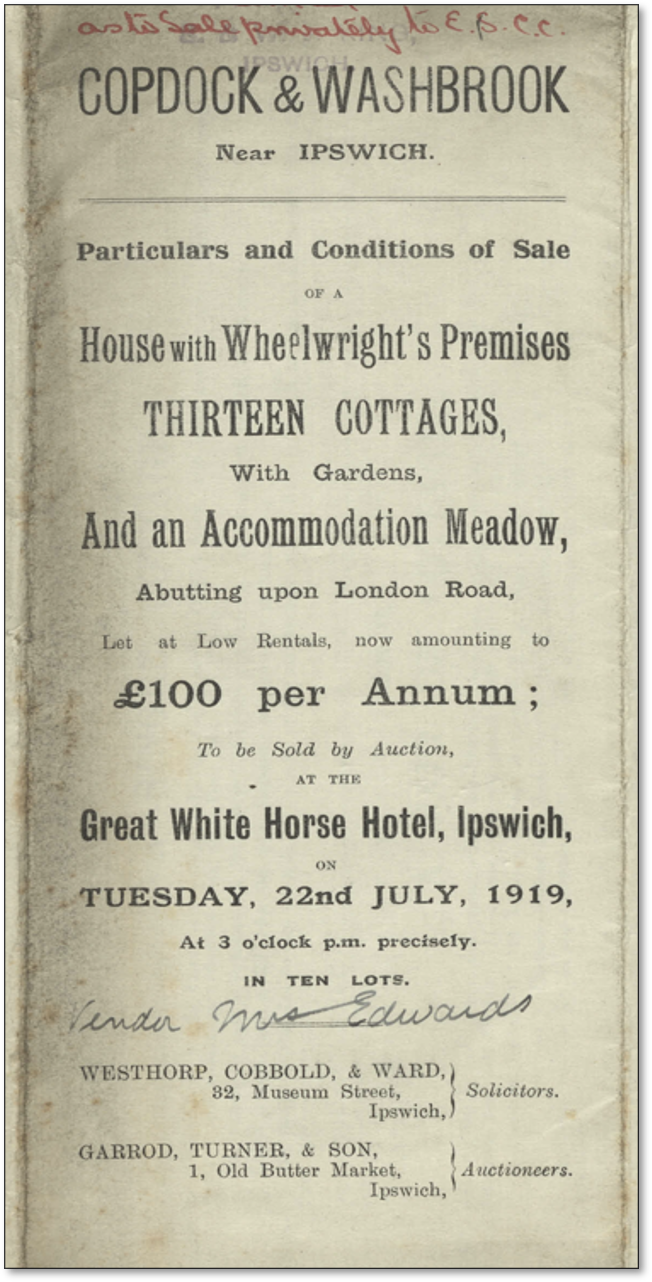
Emma Edwards died on 27th October 1920, aged 87 at a care home in Bramford, Suffolk where her daughter Georgina Robinson worked. Georgina registered her mother’s death, Emma Edwards was buried at Washbrook church on 30th Oct 1920. She left no will.
The Stebbings Family; Ownership of Stebbings 1919 – 1954
Frederick Stebbings, builder/foreman moved into Stebbings around 1897 with his wife Rachel. They were renting from the Edwards family. Their first child was born in Washbrook that year. Frederick and Rachel had six children at Stebbings.
John Frederick in 1897
Herbert Elijah in 1899
Dora Millicent in 1901
Frederica May in 1905
Cecil William in 1907
Elsie Hilda in 1909.
The oldest of Frederick and Rachel Stebbings’ children, John Frederick Stebbings, died on the 10th May 1917 in Flanders, he was just 19 years old. John Stebbings is on the village war memorial at Copdock church.
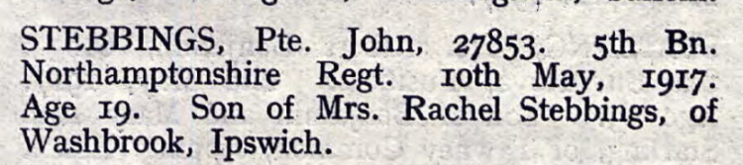
In 1919 the Edwards family decided to auction all their property in Washbrook, and the deeds show that Frederick Stebbings purchased this property, Stebbings, from Keziah Edwards.

In the 1921 census Frederick was shown as a carpenter, Frederick and Rachel Stebbings had 4 children at home and one granddaughter, their daughter Dora Stebbings was unmarried and the mother of Dorothy Kathleen Stebbings. A search of marriage indexes showed that Dora married John Vince in October 1922. Frederica aged 16 was missing from this census, and searches showed that she was a domestic servant to Charles and Ethel Eley in East Bergholt.
Further searches showed that Frederick and Rachel’s granddaughter Dorothy Kathleen married William Barron in 1939, then went on to marry Frederick Spencer Gladwell who was part of the Gladwell’s milling family in Copdock which still exists today.
Frederick’s wife Rachel Stebbings died in 1931 aged 61 and was buried at Copdock church.
In the 1939 register Frederick, a widower, was a master builder, his daughter Frederica, 34 was at home, and his granddaughter, Dorothy Stebbings aged 20 was also living with him. Dorothy was 20, working in underwear, and about to marry her husband, William Barron, a bricklayer. Dorothy may have been working at William Pretty’s, a well-known lingerie manufacturer operating in Ipswich at this time. Dorothy’s mother, Dora lived at the other end of the village with her husband, John Vince and two teenage children.
Frederick Stebbings died on 16th June 1954. He was buried in Copdock next to his wife, Rachel. Probate was granted to two sons, Herbert and Cecil Stebbings. Herbert and Cecil Stebbings sold Stebbings to Harold Peck.

Harold Peck; Ownership of Stebbings 1954 – 1963
Harold Richmond Peck was 57 and a farmer from Little Bealings, Suffolk, and the son of a farmer and hay and corn merchant from Ipswich. Harold purchased Stebbings in 1954 and was here for about 9 years, Harold was the first resident to give this property a name “Richmond House”. Harold also bought one of the Chelmesis cottages from Jean Merry Motson, a midwife from Edinburgh.
Other owners between 1963 – 2017 hidden for privacy
Sheila & Peter Herd; Ownership of Stebbings 27th July 2017 to date
We bought the property Stebbings because it had business premises and outbuildings on site, we have a small financial services practice, I’d had an inheritance which we were able to put down as a deposit. We fell in love with the house and location.
A Complete Timeline of the Ownership & Occupancy of Stebbings & Chelmesis Going Back Through Time
Date: | Stebbings | Chelmesis 1 (Gainsborough) | Chelmesis 2 (Chelmesis) | Chelmesis 3 (Inglenook) |
July 2017 onwards | ||||
Sheila & Peter Herd | Owner N/K | A young family |
| |
1954 - 1964 | Harold Richmond Peck
| N/K | N/K | N/K |
1956 | Harold Richmond Peck
| N/K | N/K | Harold Richmond Peck owned
|
1939 | Frederick Stebbings
| Lingley family | Marven family | Jean Merry Motson a midwife from Edinburgh |
June 1921 | Frederick Stebbings
| Robert & Charlotte Cook | Marven family | Day family |
July 1919 Purchasers at Edwards' family auction. | Frederick Stebbings | George Frederick Dunt | Charles Marven | George Frederick Dunt. (Day family occupied)
|
April 1911 | Emma Edwards owned / the Stebbings family occupied | Emma Edwards owned / Robert & Charlotte Cook occupied | Emma Edwards owned / Marven family occupied | Emma Edwards owned / Day family occupied |
April 1901 | Emma Edwards owned / Stebbings family occupied | Emma Edwards owned / Robert & Charlotte Cook occupied
| Emma Edwards owned / Marven family occupied | Emma Edwards owned / Day family occupied |
April 1891 | George Edwards the younger owned & occupied | George Edwards the younger owned / Cook family occupied
| George Edwards the younger owned / Marven family occupied | George Edwards the younger owned / Day family occupied |
April 1881 | George Edwards the younger owned & occupied | George Edwards the younger owned / Cook family occupied
| George Edwards the younger owned / Marven family occupied | George Edwards the younger owned / Parker family occupied
|
April 1871 | George Edwards the younger owned & occupied | George Edwards the younger owned / Cook family occupied
| George Edwards the younger owned / Marven family occupied | George Edwards the younger owned / Parker family occupied
|
Feb 1868 | George Edwards the younger owned & occupied | George Edwards the younger owned / Cook family occupied
| George Edwards the younger owned / Marven or Ridgeon family occupied
| George Edwards the younger owned / Parker family occupied |
April 1861 | George Edwards the younger owned & occupied | George Edwards the younger owned / Cook family occupied
| George Edwards the younger owned / Ridgeon family occupied
| George Edwards the younger owned / Parker family occupied |
Oct 1853 | George Edwards the younger owned / Parker family occupied | George Edwards the younger owned / Cook family occupied
| George Edwards the younger owned / Ridgeon or Plumb family occupied
| George Edwards the younger owned / Parker family occupied |
April 1851 | John Cole owned / George Edwards the younger occupied | George Edwards the younger owned / Cook family occupied
| George Edwards the younger owned / Plumb family occupied
| George Edwards the younger owned / Parker family occupied |
Jan 1847 | John Cole owned / George Edwards the younger occupied | George Edwards the younger owned / Cook family or John Gentry occupied
| George Edwards the younger owned / Plumb family occupied
| George Edwards the younger owned / Parker or Laws family occupied |
June 1841 | John Cole owned / George Edwards the elder occupied
| Amy Christie owned / John Gentry occupied
| Amy Christie owned / Plumb family occupied | Amy Christie owned / Laws family occupied |
1838 | John Cole owned / George Edwards the elder occupied
| Amy Christie owned / Martin Parker occupied
| Amy Christie owned / Plumb family occupied | Amy Christie owned / Robert Chisnall occupied |
Jan 1827 | John Cole owned / George Edwards the elder occupied
| John & Amy Christie owned | John & Amy Christie owned | John & Amy Christie owned |
June 1825 | Thomas Andrews owned / George Edwards the elder occupied
| John & Amy Christie owned | John & Amy Christie owned | John & Amy Christie owned |
April 1825 | Thomas Andrews owned / George Edwards the elder occupied
| John & Amy Christie owned | John & Amy Christie owned | John & Amy Christie owned |
May 1824 | John & Amy Christie owned
| John & Amy Christie owned | John & Amy Christie owned | John & Amy Christie owned
|
Jan 1824 | John & Amy Christie owned all of it, Stebbings & Chelmesis. Thomas Carrington / George Chisnall & others, & then Martin Parker, George Chisnall & Thomas Carrington occupied.
| |||
Mar 1821 | Thomas & Mary Wilson, John Ling of Framsden, Suffolk, shoemaker, Joseph Farrow of London, lacemaker, James Woolnough of Ipswich, bricklayer, & Mary his wife, Judith Ladbrook of Thorrington, Essex, widow, William Ling of Ipswich, labourer, Mary Bryant of Witnesham, Suffolk, widow, Judith Goss of Westerfield, Suffolk, widow, John Sones, of Walton, Suffolk, labourer & Rebecca his wife & John Thorne of Witnesham, Suffolk, labourer all owned. George Chisnall & others occupied. | |||
May 1802 | Elizabeth Rowland owned
| |||
Mar 1799 | Joseph & Elizabeth Rowland owned
| |||
April 1787 | Sarah Haywood (nee Rowland) owned
| |||
May 1733 | Anne Green owned
| |||
May 1718 | John & Mary Clarke’s children: Peter Clarke of Ipswich, maltster, Joseph Clarker of Ipswich, joiner, Samuel Lockwood, joiner, of Ipswich & his wife Mary (nee Clarke), Goodchild Clarke of Ipswich, gentleman, William Fallows of Holbrook, yeoman & his wife Elizabeth (nee Clarke), Stephen Clarke of Copdock, yeoman, Sarah Clarke of Copdock, spinster, Roger Clarke of Dedham, Essex, yeoman.
| |||
April 1714 | Mary Clarke
| |||
Oct 1697 | John & Mary Clarke
| |||
Another unknown John Clarke
| ||||
1606 | John Smarte
| |||
Pre 1606 | Richard Smarte
| |||
N/K | William Clarke; son of Richard Clarke the younger
| |||
1543 | Margaret Clarke; wife of Richard Clarke the younger
| |||
1526 | Richard Clarke the younger; son of Joan & Richard Clarke
| |||
Pre 1526 | Joan Clarke & husband Richard Clarke the elder | |||


Comments